TrustPoint Services Ticker
Living Trusts
Property Deeds & E-Recording
Probate Petitions
Civil Complaints & Responses
Bankruptcy & Debt Relief
Criminal Expungement
Living Trusts
Property Deeds & E-Recording
Probate Petitions
Civil Complaints & Responses
Bankruptcy & Debt Relief
Criminal Expungement
Divorce Deed Transfer · California · LDA #268

Remove Your Ex-Spouse From the House Title — Without Losing Prop 13

Need a divorce deed transfer in California? Your divorce judgment says you keep the house — but until a new transfer is recorded with the County Recorder, your ex is still legally on title. We prepare the right form for your marital settlement agreement (interspousal, quitclaim, or grant), file the spousal-exemption language so the County Assessor does not reassess your home to current market value, and e-record the deed transfer without reassessment same business day in all 58 California counties — for a flat $275. It must be recorded within one year of your judgment for the spousal exemption to apply.

Same-Day E-Record · 58 CA Counties
01

What Is a Divorce Deed Transfer — And Why You Cannot Wait

How to remove ex-spouse from the deed: your divorce judgment or marital settlement agreement says one spouse keeps the house — but the County Recorder still shows both names on title until a new recording happens. That mismatch creates real problems: refinancing the mortgage, selling, claiming homestead, or qualifying for senior tax transfers all require clear sole ownership.

To transfer house in divorce, California gives divorced spouses a one-year window from the judgment date to record it under the spousal exemption. Inside that window, the County Assessor treats the transfer as no change in ownership — you keep your existing Prop 13 base year value. Outside that window, the Assessor can treat it as a regular sale and reassess at market value.

The right instrument is usually an interspousal transfer deed because it contains the statutory spousal-exemption recital and the documentary transfer tax exemption declaration. A quitclaim works when the marital settlement agreement names that form specifically, but it needs the same exemption language hand-drafted to avoid reassessment.

California divorce property settlement signing — wedding rings on marital agreement contract before recording the divorce deed transfer
02

Interspousal vs Quitclaim — Which Deed Do You Use?

The marital settlement agreement (or judgment) usually names the deed type. If it does not, the choice comes down to how cleanly you want the Prop 13 spousal-exemption to apply at recording and whether the receiving spouse needs warranty of title for a future refinance or sale.

Interspousal Transfer Deed

  • Spousal exemption built in. Contains the California spousal-exemption recital so the County Assessor does not reassess.
  • Documentary transfer tax exemption. Standard $1.10 per $1,000 transfer tax does not apply — the recital is on the face of the document.
  • Transmutation language. Includes the express California transmutation declaration so community property cleanly becomes separate property of one spouse.
  • Cleanest path for refinance. Lenders and title companies treat interspousal as the standard divorce instrument.

Quitclaim Deed in Divorce

  • Named in your marital settlement. If the agreement says “quitclaim deed” we use that form — with the spousal-exemption language drafted in.
  • No warranty of title. Conveys only whatever interest the giving spouse holds — the receiving spouse has no recourse if title turns out defective.
  • Exemption language must be added. A blank quitclaim form lacks the spousal-exemption recital — we draft it in so the County Assessor honors the exemption.
  • Common but riskier. Self-prepared quitclaims downloaded from county sites often miss the recital and trigger reassessment. We walk you through both options and you decide which path to move forward.
03

6 Divorce Property Situations We Handle Daily

Every California separation eventually touches the marital home. Below are the six most common situations — each qualifies for the spousal exemption when recorded inside the one-year window.

One Spouse Keeps the House

Most common. The marital settlement awards the home to one spouse; we prepare the interspousal or quitclaim transferring the departing spouse’s interest. Recorded inside the one-year window so the spousal exemption applies.

No Prop 13 reset

Spousal Buyout — Buy Out Spouse House

One spouse pays the other for their share of the home equity in a buy-out. It transfers full title to the buying spouse; the buyout is documented in the marital settlement agreement and on the PCOR — still excluded from reassessment.

Buyout · Exempt

Refinance to Remove Mortgage Liability

Deed off title does not remove the departing spouse from the mortgage note. The keeping spouse refinances into a sole-name loan; the divorce transfer files concurrently. Lenders require both moves to release the ex from liability.

Refi pairing

Sale to Third Party With Proceeds Split

When the settlement requires the home to be sold and proceeds divided, both spouses remain on title through the sale. We can prepare a sole-and-separate transfer first if the marital settlement specifies it, then escrow handles the final sale conveyance.

Settlement-driven

Ex-Spouse Will Not Sign

Court order in lieu of signature. We prepare the documents plus the court-order package the divorce judge signs — substituting the court’s authority for the missing spouse’s signature so the County Recorder accepts the filing.

Court order package

Recording After the 1-Year Window

If more than a year has passed since the judgment, the spousal exemption may not apply automatically — we prepare the supplemental claim documentation the County Assessor needs to honor the exemption retroactively when the facts support it.

Late recording
04

How It Works — 4 Steps, Same Day

From online intake to electronically recorded filing in one business day. We walk you through the form choice and you decide which option fits your divorce judgment.

Quinnie Do, Registered Legal Document Assistant LDA #268, reviewing California divorce deed paperwork and marital settlement agreement at TrustPoint San Jose office
01

Online Intake — 10 Minutes

Upload your divorce judgment (or marital settlement agreement), the current grant deed showing both names on title, and the APN. We confirm the recording deadline and identify which form your settlement specifies.

02

We Prepare Your Filing

Drafted with the California spousal-exemption recital, the documentary transfer tax exemption declaration, sole and separate transmutation language where applicable, the legal description from the prior title, and the Preliminary Change of Ownership Report (PCOR).

03

Sign & Notarize

Walk-in at our San Jose office at 434 Blossom Hill Road, or we coordinate a mobile notary anywhere in California through our same-office partner. If your ex-spouse refuses to sign or cannot be located, we prepare the court-order package the family-court judge signs in their place.

04

Same-Day E-Recording

We electronically submit to the County Recorder for your property’s county. Filings delivered before noon are typically recorded the same afternoon; the recorded copy is emailed back to you within 24 hours. We file in all 58 California counties.

05

Divorce Deed Cost — $275 Flat + Add-Ons

Wondering the cost to remove spouse from deed in California? No hourly billing, no document-by-document charges. The flat fee covers preparation, the spousal-exemption recital, the PCOR, and one revision. Optional services and county recording fees are listed separately so the total is transparent before you sign.

Fountain pen signing California divorce settlement filing next to coins representing flat $275 fee with no Prop 13 reassessment
Divorce Deed Transfer
$275
Electronic Recording Same-day submission to County Recorder (all 58 California counties)
+ $50
Pre-Recording Title Search Confirms current vesting, lien status, and legal description before drafting
+ $30
Notarization Per signature at our San Jose office; mobile notary available statewide
+ $15
Court-Order Package (when ex won’t sign) Substituted-signature filing for the divorce court — quoted at intake
Quote
County Recording Fee — Two Tiers
Primary residence (owner-occupier) ≈ $65
Investment / non-owner-occupier ≈ $165
SB2 owner-occupier exemption applies to primary-residence transfers under California’s SB2 fee schedule. Final county fee confirmed at order. Documentary transfer tax: $0 on qualifying spousal transfers.
06

The Wrong Deed Can Cost You $50,000+

Five California-specific risks the County Assessor, County Recorder, and divorce courts look for. Each one can be avoided when prepared correctly and recorded inside the one-year window.

Divorcing California couple sitting apart with divorce form and wedding ring on table before recording the property deed transfer

DIY or Wrong-Form Risks

  • Recorded after the 1-year window. The spousal exemption requires recording within one year of the judgment. Miss the deadline and the transfer can be reassessed at current market value — potentially adding tens of thousands per year to your tax bill.
  • Quitclaim without exemption language. A blank quitclaim downloaded from the county website lacks the spousal-exemption recital — the County Assessor treats the recording as an ordinary change in ownership.
  • Deed and mortgage confused. Removing the ex from title does not remove them from the mortgage. A refinance into a sole-name loan is a separate transaction the keeping spouse must qualify for independently.
  • Form does not match the marital settlement. If the divorce judgment names a specific form, recording a different one can trigger a challenge in family court — especially when the ex contests the property transfer later.
  • PCOR not attached. The Preliminary Change of Ownership Report must accompany every transfer. The Assessor charges a penalty if it’s missing and may treat the filing as suspicious until reconciled.

TrustPoint LDA #268

  • Recorded inside the 1-year window. We confirm the judgment date at intake and prioritize filing well before the deadline so the spousal exemption applies cleanly.
  • Spousal-exemption recital on every filing. Whether your marital settlement names interspousal or quitclaim, the spousal-exemption + documentary transfer tax exemption language is drafted in.
  • Title-mortgage coordination. We explain how the transfer and refinance work together so the keeping spouse gets clear title AND the ex is released from mortgage liability through the lender.
  • Court-order package when needed. If your ex refuses to sign or cannot be located, we prepare the substituted-signature package the divorce court signs — so the County Recorder still accepts the filing.
  • Four California licenses under one roof. Registered LDA #268, Notary Public, IRS Tax Preparer, and Real Estate Agent — the Real Estate license matters specifically for divorce property work because vesting, Prop 13, and community-property division are real estate disciplines.
07

Prepared By Quinnie Do, LDA #268

Quinnie Do, Registered Legal Document Assistant LDA #268 Santa Clara County, founder of TrustPoint preparing California divorce deed transfers
Quinnie Do
REGISTERED LDA #268 · NOTARY · IRS TAX PREPARER · REAL ESTATE AGENT

Quinnie founded TrustPoint to make California deed transfers, divorce paperwork, and estate documents accessible to working families — especially Vietnamese (Tiếng Việt) and Spanish-speaking (Español) neighbors who were quoted $1,000–$1,500 by attorneys for a paperwork-only filing. Personally trilingual in English and Vietnamese with Spanish-speaking staff partner support, and one of the few Registered LDAs in California also licensed as a Real Estate Agent — the discipline that matters specifically for divorce property division, vesting, and Prop 13 questions. Verify LDA #268 on the Santa Clara County Clerk-Recorder website ↑︎ or view CALDA member profile ↑︎.

08

Divorce Deed Questions

The two California options in divorce are the interspousal transfer deed and the quitclaim deed. It is purpose-built for spousal transfers and contains the statutory spousal-exemption recital and the documentary transfer tax exemption declaration on its face. A quitclaim deed is also acceptable when the marital settlement agreement names that form — but the exemption language must be drafted in or the County Assessor can treat the transfer as a regular change in ownership. The marital settlement agreement (or divorce judgment) usually names the deed type; if it does not, we walk you through which option fits your situation and you decide which to move forward.

One year from the judgment date. Inside that window, the California spousal exemption applies automatically — the County Assessor treats the deed as no change in ownership and your Prop 13 base year value stays the same. Outside that window, the Assessor can treat the transfer as a regular sale and reassess the home to current market value — potentially adding tens of thousands of dollars per year to your property tax bill. We prioritize divorce filings inside the one-year window.

No — does it remove mortgage liability? No, it does not. The deed and the mortgage are separate contracts. A divorce transfer puts the keeping spouse on sole title; it does not remove the departing spouse from the mortgage note. To release your ex from mortgage liability, the keeping spouse refinances into a sole-name loan they qualify for independently. The two moves happen together — the deed transfer and the refinance close concurrently (and the federal Garn-St Germain Act protects spousal transfers from the lender’s due-on-sale clause) — but they are two separate transactions. We coordinate timing so the recording happens as part of the refinance closing when that’s how your divorce settlement is structured.

TrustPoint prepares the divorce deed for a flat $275, which includes preparation, both spousal-exemption recitals, the Preliminary Change of Ownership Report (PCOR), and one revision. Add-ons: e-recording $50, pre-recording title search $30, notarization $15 per signature. County recording fees are approximately $65 for an owner-occupier primary residence or $165 for an investment property. Documentary transfer tax is $0 on qualifying spousal transfers in divorce. Compare that to Bay Area attorneys, who typically charge $500–$1,500 in attorney fees for the same paperwork and often take 2–4 weeks.

The California family court can sign for them. When a spouse refuses to sign the documents required by the marital settlement, the keeping spouse files a request with the family court that issued the divorce judgment. The judge signs an order substituting the court’s signature for the missing spouse’s — the County Recorder accepts that order plus the filing and records the transfer. We prepare the substituted-signature court-order package alongside it when your situation requires it. Pricing for the court-order package is quoted separately at intake because complexity varies.

TrustPoint prepares and e-records your divorce deed the same business day. After online intake (about 10 minutes uploading your divorce judgment and current title), it is drafted with all statutory recitals, you sign and notarize, then we e-submit to the County Recorder. Filings delivered before noon are typically recorded the same afternoon; the recorded copy is emailed back within 24 hours. We file in all 58 California counties.

California law does not require an attorney for this work. A Registered Legal Document Assistant under California’s LDA law can prepare grant deed, quitclaim deed, interspousal transfer deed, trust transfer deed, and correction filings — at a flat fee. Attorney involvement is the right fit for contested property division still being litigated, contested transmutation claims, or situations where the divorce judgment itself is being challenged — we walk you through the situations where that applies and you decide. For a settled case where the judgment names the form and both spouses cooperate, an LDA is the appropriate and cost-efficient path.

Usually no — once a California divorce petition is filed and served, an automatic temporary restraining order prevents either spouse from conveying real property without court authorization or a written agreement signed by both spouses. It is typically recorded after the judgment is entered and the marital settlement agreement is incorporated into the judgment. If you and your spouse have signed a stipulated settlement that specifically authorizes the transfer earlier, we can prepare the documents for that earlier recording.

Divorce Deed Recording — All 58 California Counties

Where do I record divorce deed transfer California filings? Each one is recorded with the County Recorder where the property is located — from Silicon Valley to the rest of California. We e-record in every county and the recorded copy returns to you by email.

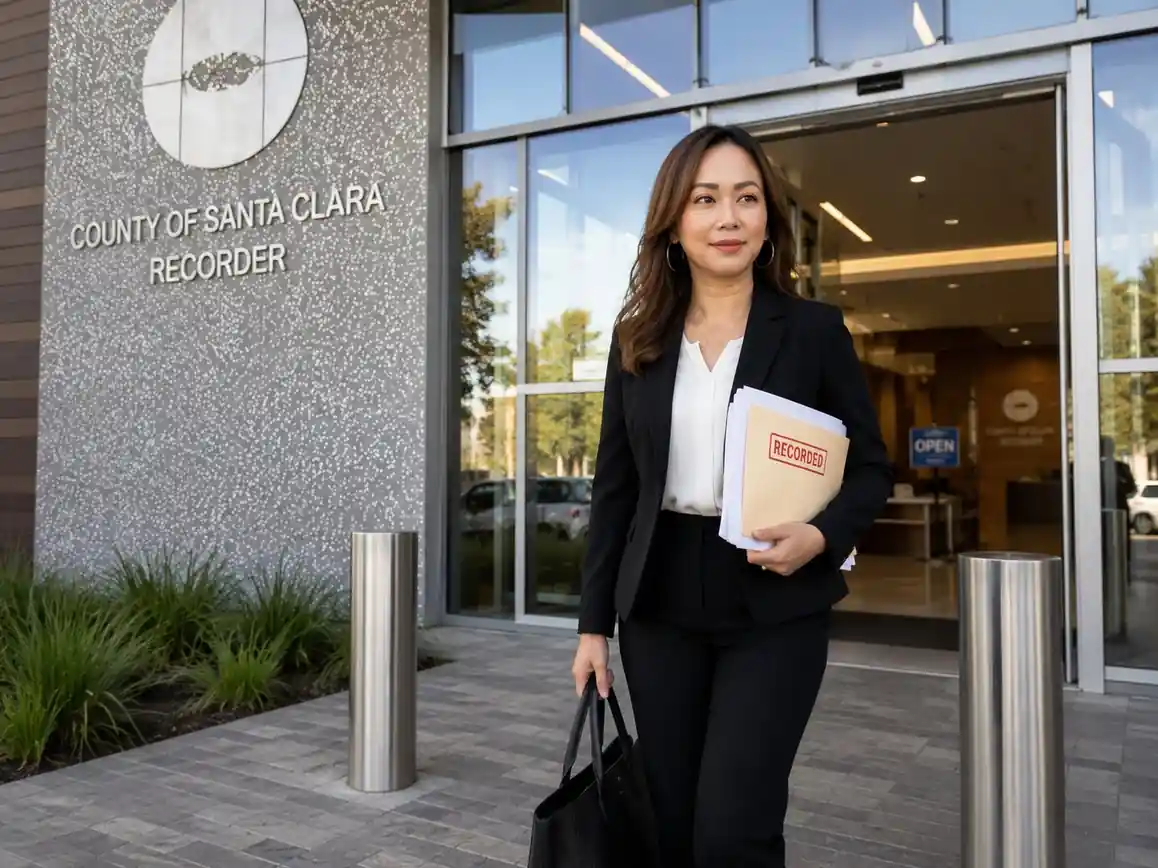
Quinnie Do LDA #268 outside the County of Santa Clara Recorder office with recorded California divorce property documents
Santa Clara Alameda San Mateo Contra Costa San Francisco Monterey San Benito Santa Cruz Marin Sonoma Napa Solano Los Angeles Orange San Diego Riverside San Bernardino Ventura Sacramento San Joaquin Stanislaus Fresno Kern Santa Barbara + 34 more
Trusted Office Partner

Need a notary, process server, or marriage certificate apostille?

Our same-office partner Fingerscan Digital handles notary, mobile notary statewide, process serving (for the court-order package when an ex won’t sign), and marriage certificate apostille (for spouses with international property) from the same San Jose location at 434 Blossom Hill Road.

Pair Your Divorce Deed With These Related Services

Most divorce deed transfers happen alongside a refinance, name change, or living trust update. TrustPoint prepares all of it under one roof.

Ready to Remove Your Ex From the House Title?

Free consultation by phone or video. Complete the secure intake form in about ten minutes, we prepare it with the spousal-exemption recital, and we e-record same business day in all 58 California counties — inside the one-year window.