TrustPoint Services Ticker
Living Trusts
Property Deeds & E-Recording
Probate Petitions
Civil Complaints & Responses
Bankruptcy & Debt Relief
Criminal Expungement
Living Trusts
Property Deeds & E-Recording
Probate Petitions
Civil Complaints & Responses
Bankruptcy & Debt Relief
Criminal Expungement

Transfer Rental Property to an LLC or Corporation in California — Without Prop 13 Reassessment

Transferring California property into an LLC or Corporation involves a precise grant deed, a Preliminary Change of Ownership Report (PCOR), and a declaration statement that the County Assessor reviews together with the client's entity documents. TrustPoint Disability & Legal Services LLC (LDA #268, Santa Clara County) prepares the deed, PCOR, and declaration statement for a flat $400. The client provides the entity formation paperwork — Operating Agreement or Bylaws, Articles of Organization or Incorporation, and EIN — which the County reviews alongside the deed package.

Transfer Rental Property to LLC California — The Most Common Entity Transfer

The most common entity transfer we handle is moving rental property into an LLC for liability protection. Tenant claims, slip-and-fall lawsuits, and habitability disputes can put a landlord's personal assets at risk if the rental is held in personal name. Holding the rental inside a company creates a legal separation between real estate and the owner's personal assets. The deed package on our side — grant deed, PCOR, and declaration statement — documents the ownership relationship for the County Assessor's review. Common searches for this scenario include "transfer rental property to LLC California," "form LLC and transfer property," and "deed property into my LLC."

Why California LLC and Corporation Property Transfers Need a Precise Deed

Every transfer of real property to or from a legal entity in California is a change in ownership the County Assessor reviews. The County looks at whether the people who held the property continue to hold the same proportional interests in the new entity. The deed, PCOR, and declaration statement on our side must match the ownership percentages stated in the entity's own paperwork. Inconsistencies between documents are one of the most common reasons entity transfers get reassessed.

What the $400 Flat-Fee LLC and Corporation Deed Package Includes

TrustPoint's flat $400 entity deed package covers preparation of the grant deed, the Preliminary Change of Ownership Report (PCOR), and the declaration statement. The client supplies the entity formation paperwork — Operating Agreement or Bylaws, Articles of Organization or Incorporation, and EIN documentation — which the County Assessor reviews alongside the deed package. Add-ons: electronic recording $50, deed record $30, notary $15 per grantor signature. County recording fees vary based on the property type.

How to Transfer Property to an LLC in California — Step by Step

Three steps. First, the client provides the entity formation paperwork and the ownership-percentage information. Second, TrustPoint prepares the grant deed, PCOR, and declaration statement using the client's information; the deed is notarized. Third, TrustPoint e-records the deed with the county recorder — available in all 58 California counties — and returns the recorded document within 24–48 hours.

California Entity Deed for LLC and Corporation Property Holding

The entity deed covers both LLC grant deeds and Corporation grant deeds. An LLC offers pass-through taxation and the $800 annual California Franchise Tax minimum. A Corporation offers stock-based ownership transfers but faces double taxation on C-Corp distributions. The choice depends on whether the property is held for rental income, asset protection, estate planning succession, or 1031 exchange flexibility. TrustPoint prepares both at the same $400 flat fee.

Avoiding the Due-on-Sale Clause When Moving Property to an LLC

Most California mortgages contain a due-on-sale clause that may apply when title transfers to a legal entity. Whether a specific lender enforces the clause varies by loan program and loan servicer. Bringing your loan documents to consultation lets us see the file before the deed is prepared.

Transfer Property Out of an LLC Back to Personal Name

The same flat $400 covers the reverse direction: moving real estate from an LLC or Corporation back into your personal name. Common reasons include refinancing (most residential lenders require personal title), company dissolution, preparing a property for sale, or restoring homestead exemption status. The County Assessor reviews this transfer the same way as the inbound direction, and the same three documents on our side apply: the grant deed (with the LLC or Corporation as grantor and the individual as grantee), the Preliminary Change of Ownership Report, and the declaration statement. Common searches for this scenario include "transfer property from LLC to personal California," "deed property out of LLC," and "dissolve LLC and deed property to me."

FinCEN Beneficial Ownership Reporting for LLC Real Estate Transfers

Effective March 1, 2026, the FinCEN Residential Real Estate Reporting Rule requires reporting of certain non-financed transfers of residential property to legal entities including LLCs and Corporations. Deed packages prepared by TrustPoint since March 2026 include the current FinCEN reporting information so you know what your entity faces.

Frequently Asked Questions — LLC and Corporation Property Deed California

How much does it cost to transfer property to an LLC in California? TrustPoint's flat $400 covers the grant deed, PCOR, and declaration statement — the documents we prepare. The client provides their Operating Agreement or Bylaws, Articles of Organization or Incorporation, and EIN. Add-ons: $50 e-recording, $30 deed record, $15 per notary signature. County recording fees vary.

Will transferring my property to an LLC trigger reassessment? The County Assessor reviews every entity transfer using California property tax rules. If the ownership percentages match across the deed, PCOR, declaration, and the entity's own paperwork, the County treats the transfer differently than it would treat a sale.

Can an LDA prepare an entity deed in California? Yes. California Business & Professions Code Section 6400 authorizes a registered Legal Document Assistant to prepare property transfer documents at the customer's direction. TrustPoint holds LDA #268 in Santa Clara County.

What's the difference between an LLC and Corporation deed in California? The grant deed itself is structured the same way for either entity type. The difference is the entity's own governance document — an LLC uses an Operating Agreement, a Corporation uses Bylaws. TrustPoint prepares the deed package for either entity type at the same $400 flat fee.


LLC & Corporation Deeds · California · LDA #268

Transfer Rental Property to an LLC or Corporation
Without Prop 13 Reassessment

Move rental property into an LLC or Corporation for liability protection — or transfer property out of an LLC back into your personal name. Flat $400 covers the grant deed, Preliminary Change of Ownership Report, and declaration statement. We e-record in any of California's 58 counties within 24–48 hours.

Rental Property — $400 Flat 58 California Counties 24–48 Hour Turnaround Bonded LDA #268
Investor hand with fountain pen and coins jar — California LLC property deed planning
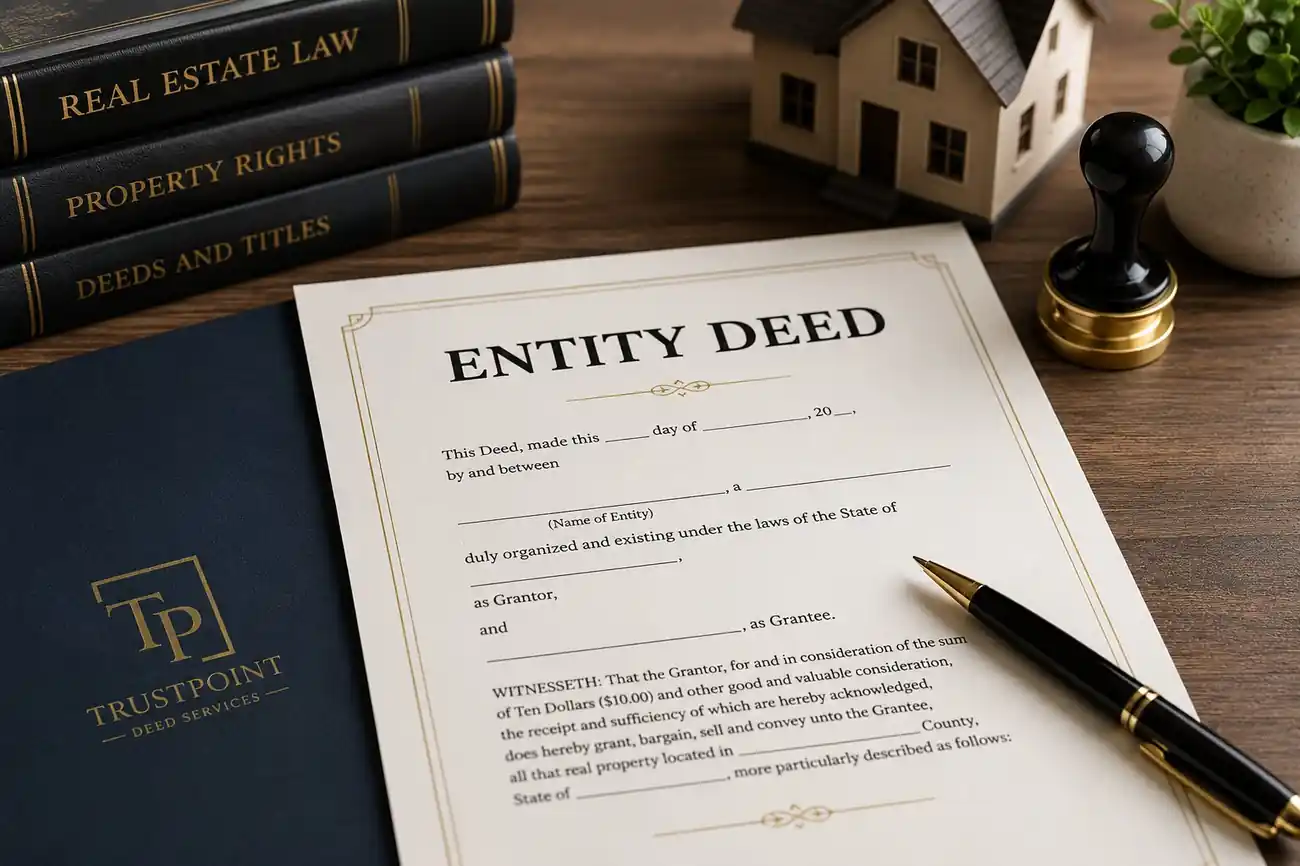
TrustPoint Entity Deed document prepared for California LLC and Corporation property transfer

Inconsistent paperwork is the most common reason transfers get reassessed. Percentages must match exactly across every document the County reviews.

Start My Deed →
Flat-Fee Pricing

One $400 Bundle for LLC or Corporation

No hourly billing. No surprise fees. Everything you need to transfer property into a California legal entity is included — for both LLC and Corporation buyers at the same flat rate.

Entity Deed Package

Bring what you have — we'll show you what's needed

$400 Flat Fee

What We Prepare

  • Grant deed — naming the grantor and the LLC or Corporation as grantee, typed from the information you provide
  • Preliminary Change of Ownership Report (PCOR) — the form the County Assessor uses to review every property transfer
  • Declaration statement — the supporting document that records what you state about ownership percentages between you and the entity

Bring What You Have

The County reviews these alongside our deed package. If you don't have them yet, we'll talk through what's involved at the consultation.

  • Operating Agreement (LLC) or Corporate Bylaws (Corporation) — your internal governance document
  • Articles of Organization (LLC) or Articles of Incorporation (Corp) — filed with the California Secretary of State
  • EIN — Employer Identification Number from the IRS for the entity

Optional Add-Ons

Electronic Recording
$50
Deed Record
$30
Notary — per grantor signature
$15
County Recording Fee
Varies
County fees vary by property type: primary residence and investment property are recorded under different fee schedules. We confirm the exact county recording fee with you before submission so there are no surprises at recording.
Both Entity Types

LLC or Corporation — Same $400

Some clients arrive with an LLC already formed; others already hold the property in a Corporation. The grant deed itself is structured the same way for either entity type — what differs is the internal governance document your entity uses. We prepare the deed package for both at the same flat fee.

LLC Structure

Limited Liability Company

An LLC typically uses pass-through taxation and a single annual filing with the Franchise Tax Board. The internal governance document is called an Operating Agreement. The $800 annual California Franchise Tax minimum applies to every California LLC.

  • Pass-through taxation on Schedule C or Form 568
  • Operating Agreement governs member rights
  • $800 annual California Franchise Tax minimum
  • Single-member or multi-member structure
Corporation Structure

Corporation (C or S)

A Corporation uses stock-based ownership and Bylaws-driven governance. The internal governance document is called the Corporate Bylaws. S-Corp election is filed separately with the IRS on Form 2553.

  • Corporate Bylaws and Board structure
  • Stock-based ownership records
  • S-Corp election filed on IRS Form 2553
  • $800 annual California Franchise Tax minimum
Both Directions

Transfer Property Out of an LLC, Too

The same flat $400 covers moving real estate out of a holding company back into your personal name — for a refinance, dissolution, a sale, or a return to homestead status. The County Assessor still reviews the transfer alongside your company paperwork, and the same three documents on our side apply.

Inbound

Property → LLC or Corporation

The classic entity transfer. Grant deed from you (the grantor) to your LLC or Corporation (the grantee). Used to move rental property into a holding entity, transfer your house into a family LLC, or move real estate into a Corporation for business operating use.

  • Transfer rental property to LLC California
  • Transfer house to LLC California
  • Deed property into my LLC
  • Form LLC and transfer property together
Outbound

LLC or Corporation → Personal Name

The reverse direction. Grant deed from your holding company (the grantor) to you personally (the grantee). Common when refinancing (most lenders require personal title), when dissolving the entity, when preparing for sale, or when restoring homestead status.

  • Transfer property from LLC to personal California
  • Deed property out of LLC
  • Dissolve LLC and deed property to me
  • Refinance prep — LLC to personal title
Who This Is For

Four Buyers, One Bundle

The $400 LLC or Corporation property deed serves four very different buyer situations. The deed structure is the same — what changes is what you're protecting and why.

Transfer Rental Property to LLC

The most common entity transfer we handle. Move a single rental or a full portfolio into an LLC for liability protection from tenant claims. The transfer documents the ownership relationship the County Assessor will review.

Real Estate Investors

Investors often hold each property in a separate entity. We prepare the documents for each transfer at the same flat fee, whether you're moving one property or several.

Trust + LLC Estate Plans

Many Bay Area clients hold their property inside a living trust. If the trust already owns the company, bring the trust paperwork to consultation along with the company documents, and we put together the package accordingly.

Business Owners & Operations

Operating businesses sometimes move a building or commercial property into a Corporation, or use a holding-company structure for multi-property portfolios. We prepare the transfer paperwork once your Secretary of State filings are in hand.

Why Hire Us

The $400 Risk Calculus

A wrong deed costs more than the deed prep ever saved. The most expensive mistake is the one you didn't know you made until the County Assessor's reassessment notice arrives.

DIY Templates or AI Drafts

  • Rounding-error reassessment. Inconsistent ownership percentages between the deed, the PCOR, and the company's own paperwork is one of the most common reasons the County Assessor flags a transfer for reassessment. Once a reassessment is recorded, reversing it is difficult.
  • An incomplete or missing declaration. The PCOR and the declaration statement are the documents the County Assessor uses to review every entity transfer. If they're missing or incomplete, the file goes back unprocessed or moves forward in a way that may not match what was intended.
  • Lender notification. Most California mortgages include a due-on-sale clause that may apply when title transfers to a legal entity. Whether and how lenders enforce it varies by loan program and servicer. Bring your loan paperwork to consultation so we know what the file looks like.
  • FinCEN reporting blind spot. Effective March 1, 2026, certain non-financed transfers of residential property to legal entities trigger FinCEN beneficial ownership reporting requirements. Older templates may not reflect the current rule.
  • Original co-owners trap. Once an entity transfer is recorded under the legal-entity rules, the people who held the property become the entity's "original co-owners" in the County's records. The County tracks future transfers of ownership interest going forward.

TrustPoint LDA #268

  • Exact-match proportional interests. We type the ownership percentages exactly as you provide them, identically across every document we prepare. We also walk through your company paperwork at consultation to flag any percentage mismatches before the file goes to the County.
  • Complete declaration on every file. Every TrustPoint package includes the declaration statement the County Assessor expects to see alongside the deed and PCOR.
  • Loan-document review. Many clients bring their loan documents to consultation so we have a complete picture before preparing the deed package. Whether your specific loan program allows entity transfers is something the loan servicer or your loan officer can confirm directly.
  • FinCEN-aware paperwork. Every package we prepare since March 2026 includes the current FinCEN beneficial ownership reporting information so you know what reporting your company faces going forward.
  • 58-county e-recording. Recorded in any California county within 24–48 hours via our e-recording infrastructure — something no template service provides.
How It Works

Three Steps, 24–48 Hours

From your first call to a recorded deed and a formed entity, the whole process is a handful of steps — and we handle every one of them.

1. Free Consultation

Call (408) 766-3532 or book online. We walk through the property's current title, the ownership percentages, your company paperwork (or where you are in forming it), and the loan if there is one. Bring what you have — we'll show you what else we'll need.

2. Document Preparation

We prepare the grant deed, PCOR, and declaration statement using the information and paperwork you provide. Notary $15 per grantor signature on-site.

3. E-Record & File

We e-record the transfer with your county recorder. Recorded document back within 24–48 hours.

Common Questions

LLC & Corporation Deed Questions

The questions buyers actually ask, with straight answers. If you don't see yours, call (408) 766-3532 — first consultation is free.

TrustPoint charges a flat $400 for the entity deed package. That covers what we prepare on our side: the grant deed, the Preliminary Change of Ownership Report (PCOR), and the declaration statement. You bring your Operating Agreement or Bylaws, Articles, and EIN documentation. Add-ons: $50 electronic recording, $30 deed record, $15 per grantor signature for notary. County recording fees vary.

Yes. The same flat $400 covers an outbound transfer — a grant deed from your LLC or Corporation back into your personal name. Common reasons clients ask for this: refinancing (most residential lenders require personal title before they'll quote a new loan), dissolving an LLC that's no longer needed, preparing a property for sale, or restoring homestead exemption status. The County Assessor reviews this transfer the same way as the inbound direction, and the same three documents on our side apply: grant deed, PCOR, and declaration statement.

The County Assessor reviews every transfer to a legal entity using California property tax rules. One of the rules considers whether the people who held the property continue to hold the same proportional interests in the new company — if percentages on the deed, PCOR, declaration, and entity paperwork all match, the County treats the transfer differently than it would treat a sale. TrustPoint types the ownership percentages exactly as you provide them across every document we prepare.

The grant deed itself is structured the same way for either entity type — both transfer real property to a legal entity. The differences are in the entity's own governance document and tax treatment. An LLC uses an Operating Agreement and typically pass-through taxation. A Corporation uses Bylaws and stock-based ownership records. The entity choice is one you make on your side; TrustPoint prepares the deed, PCOR, and declaration statement for either entity type at the same $400 flat fee.
Yes. California Business & Professions Code Section 6400 authorizes a registered Legal Document Assistant to prepare property transfer documents at the customer's direction. TrustPoint prepares the grant deed, PCOR, and declaration statement on your behalf. TrustPoint Disability & Legal Services LLC holds LDA #268 in Santa Clara County and is an active member of CALDA.

The due-on-sale clause in most mortgages allows the lender to demand full repayment when title transfers to a new owner — including a transfer to a holding entity. Whether and how a specific lender enforces this varies by loan program and servicer. Bring your loan documents to consultation so we can see the file before the deed is prepared. For specific guidance on whether your particular loan allows the transfer, the loan servicer or your loan officer is the direct source.

When property transfers into a legal entity under the legal-entity rules, the County’s records identify the people who held the property as the entity’s "original co-owners." The County continues to track ownership-interest transfers in the entity going forward, even though no new deed is recorded for those changes. This is one of the topics we walk through at consultation so you know what the County is tracking.

Ocean Avenue LLC v. County of Los Angeles is a 2018 California appellate case that clarified how legal-entity ownership changes are tracked over time. The court reinforced that ownership changes are measured cumulatively under California property tax rules — small transfers add up. If you plan to gift entity interests to family members over the years, the tracking rules can interact in ways that affect future County assessments. This is another topic we walk through at consultation.

Possibly. The FinCEN Residential Real Estate Reporting Rule took effect March 1, 2026 and requires reporting of certain non-financed transfers of residential property (one-to-four family units) to legal entities. Cash transfers to entities are the most common trigger. Every deed package we prepare since March 2026 includes the current FinCEN reporting information so you know what your entity faces. Beneficial ownership information is reported to FinCEN, not made public.

The company must legally exist before it can be named as grantee. You file your Articles with the California Secretary of State first, then bring the confirmation to us. We prepare the grant deed, PCOR, and declaration once we have the filing confirmation. Typical end-to-end timeline is 24–48 hours from notarization to recorded document once everything is in hand. Typical end-to-end timeline is 24–48 hours from notarization to recorded deed once the entity is formed.

Yes — many Bay Area families hold their property inside a living trust that owns their LLC or Corporation. If your structure is already set up this way, bring the trust paperwork to consultation along with the company documents, and we prepare the package accordingly. If you have a living trust prepared by TrustPoint, let us know at consultation and we'll pull your file. If you don't have a trust yet, we offer flat-fee living trust preparation alongside the entity deed.

Every California legal entity pays a $800 annual minimum franchise tax to the Franchise Tax Board, due April 15 each year. Additional fees apply once gross income exceeds $250,000 annually. This is the ongoing cost of maintaining the entity — not a TrustPoint fee. Your first $800 may be due in the entity's first taxable year depending on formation date. We walk you through the calendar at consultation.

All 58. TrustPoint e-records transfers in every California county — Santa Clara, Alameda, Contra Costa, San Mateo, San Francisco, Los Angeles, Orange, San Diego, Fresno, and the rest. Same-day to 24–48-hour turnaround depending on the county recorder's processing window. See our e-recording services hub for county-by-county details.

Quinnie Do, Registered Legal Document Assistant LDA #268, Santa Clara County
Quinnie Do
Registered LDA #268 · Notary · IRS Tax Preparer · CA Real Estate Agent

Quinnie founded TrustPoint to make California legal paperwork accessible and affordable for the South Bay's working families and small investors. With four California licenses under one roof — Legal Document Assistant, Notary Public, IRS Tax Preparer, and Real Estate Agent — she brings cross-disciplinary fluency to entity deed work that most LDAs and most attorneys can't match.

Personally trilingual in English and Vietnamese, with a Spanish-speaking staff partner, Quinnie has prepared thousands of property deeds, living trusts, probate petitions, civil filings, and disability applications since 2020. Verify LDA #268 on the Santa Clara County Clerk-Recorder website or view the CALDA member profile.

Ready to Move Your Property into an LLC or Corporation?

Flat $400. All-inclusive. Recorded in 24–48 hours across all 58 California counties. First consultation is free — call or book online.

$400 Flat LLC/Corp Transfer58 California Counties · 24–48 hrs

Start My Deed →